ChatGPT Codex vs Claude Code: 3.4x Cost Gap Across 47 PRs (2026)
Which is better in 2026, ChatGPT Codex or Claude Code? After 31 days and 47 merged PRs across both agents, my honest answer is neither, exactly — one tool cost me 3.4x the other per PR, but the loser at cost was the winner at refactors, and vice versa on greenfield work. Same output. Same me driving. The total bill for the month was $297.14, and forcing yourself onto a single tool means roughly half your work lands on the wrong side of that 3.4x gap. That’s why I still pay for both.
Updated August 2026 — model defaults and price tiers move fast, so I re-checked both ladders. The per-task split and the 3.4x cost gap below have held across the intervening releases.
One clarification up front: “ChatGPT Codex” here means the modern OpenAI Codex agent (the codex-1 fine-tune, GA in Feb 2026), not the 2021 code-completion API of the same name. Web Codex (in the ChatGPT UI) and CLI Codex share the same backend; I used the CLI for this test.
For months before that, my AI coding setup was a junk drawer. Aider, Continue, OpenClaw, three VS Code plugins I never fully understood, an .envrc with API keys for providers I’d forgotten I had. Then in April 2026, Anthropic tightened the rules on third-party clients hitting Claude Max, and half my drawer stopped opening.
That should have been the panic moment. It wasn’t. I nuked everything except Claude Code and ChatGPT Codex, the two official agents from the labs that train these models themselves. Awkward price point on both, though: about $100/month once you step up from the entry tier.
I gave myself a week to pick a winner. A month in, I’m still on both, and I’ve stopped looking for one.
Two tools, two different jobs
Which should you pick — ChatGPT Codex or Claude Code? Short version: Claude Code is a synchronous pair programmer in your terminal, Codex is an asynchronous intern that returns a PR from the cloud. If you’d rather interrupt an agent mid-edit, pay Anthropic; if you’d rather queue five tasks and review PRs after lunch, pay OpenAI. The rest of this section is why that framing beats a spec-sheet duel.
It’s easy to lump Claude Code and Codex together as “competitors.” They are, sort of, in the way a chef’s knife and a slow cooker compete. Both produce dinner. Compare them on a spec sheet and you’ll miss the bigger story.
Claude Code lives in your terminal. You run claude inside a project directory and it gets full read/write access to your filesystem. It edits files in real time, right in front of you. When it heads the wrong way, you cut it off mid-sentence, push back, redirect, and the conversation just keeps going. Think of it as a pair programmer who happens to read very fast.
ChatGPT Codex lives in the cloud. You give it a task, it spins up a sandbox, clones your repo from GitHub, and hands you back a pull request whenever it’s finished. Queue five tasks before lunch, review the PRs after. It’s closer to an intern who works from home and only submits when the report is done.
Same output: you get code either way. Beyond that, they overlap almost nowhere.
Alright, the spec sheet
ChatGPT Codex vs Claude Code, one paragraph: Claude Code runs on your laptop with real filesystem access, defaults to Claude Sonnet 4.6, and comes bundled in the $20 Pro plan. Codex runs in OpenAI’s cloud, defaults to GPT-5.3 Codex (the codex-1 fine-tune), and unlocks fully at Codex Pro ($200). Claude leads on independent code-quality reviews; Codex leads on Terminal-Bench 2.0. Neither wins across every axis, which is exactly why the split below matters more than the totals.
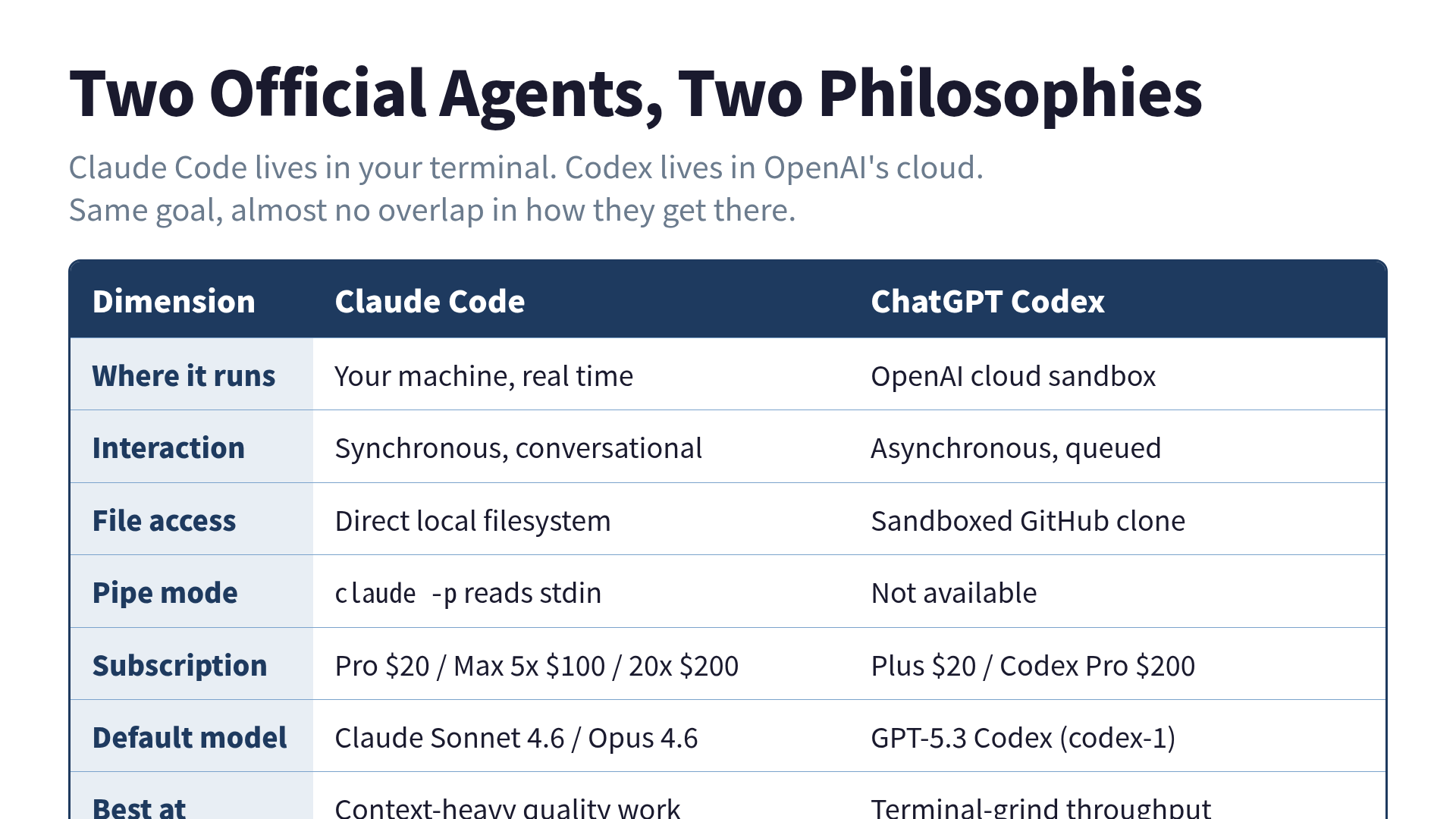
Here’s the cheat sheet I keep in a Markdown file, because I forget half of this twice a week:
| Dimension | Claude Code | ChatGPT Codex |
|---|---|---|
| Where it runs | Your machine | OpenAI’s cloud |
| Interaction | Synchronous, conversational | Asynchronous, queued |
| File access | Direct local filesystem | Sandboxed clone of your GitHub repo |
| Pipe mode | claude -p reads stdin | No |
| Subscription | Pro $20, Max 5x $100, Max 20x $200 | ChatGPT Go $8, Plus $20, Codex Pro $200 |
| Default model | Claude Sonnet 4.6 / Opus 4.6 | GPT-5.3 Codex (codex-1 fine-tune of o3) |
| Best benchmark right now | 67% win rate on independent code-quality reviews | 77.3% on Terminal-Bench 2.0 |
| Voice / mobile flow | Limited | Voice input, mobile review of PRs |
Two things stand out. The price ladders don’t line up. Claude’s Pro tier ($20) already bundles Claude Code, whereas OpenAI’s $20 ChatGPT Plus doesn’t unlock unlimited Codex usage, and the dedicated Codex Pro plan lands all the way at $200. The benchmark leaderboards also flip depending on what you’re measuring: long, context-heavy code quality goes to Claude, while pure terminal-grind throughput goes to Codex. Blanket “X is better at coding” claims usually just mean the speaker measured one axis and stopped.
How each one feels day to day
Specs are easy to publish and easy to bicker about. The feel of a tool is a different thing; you only get that by using it for a while.
Claude Code feels like editing a Google Doc with a fast colleague reading over your shoulder. You type a request, and files start changing. If it heads the wrong way on line 4, you can say “no, drop the Redis cache, just use SQLite” and it will back out. Worst case, you hit Ctrl-C. The trade-off is that you have to be there. Claude Code is bad at the kind of task you’d fire off and walk away from, because it expects you to keep the conversation going.
Codex feels like emailing someone in another time zone. You write up a clear ticket, hit send, go do something else. A PR turns up later, and if it’s wrong, you file another ticket. It can’t clobber your local Postgres because it isn’t on your machine to begin with. The sandbox is the safety net. The downside: ambiguous instructions don’t get clarified. They get interpreted, and you learn about it three hours later.
I spent two weeks trying to survive on just one of them. Both experiments ended badly. Claude-Code-only week: I lost half a Sunday sitting through a refactor I should have queued and walked away from. Codex-only week: I burned an afternoon waiting on PRs for changes I could have made conversationally in fifteen minutes.
My mistake was treating “AI coding agent” as a single job. It’s at least two jobs: a synchronous one and an asynchronous one, sharing a job title and not much beyond that.
Using Claude Code and Codex together: the handoff workflow
Once I stopped hunting for a single winner, the workflow sorted itself out.
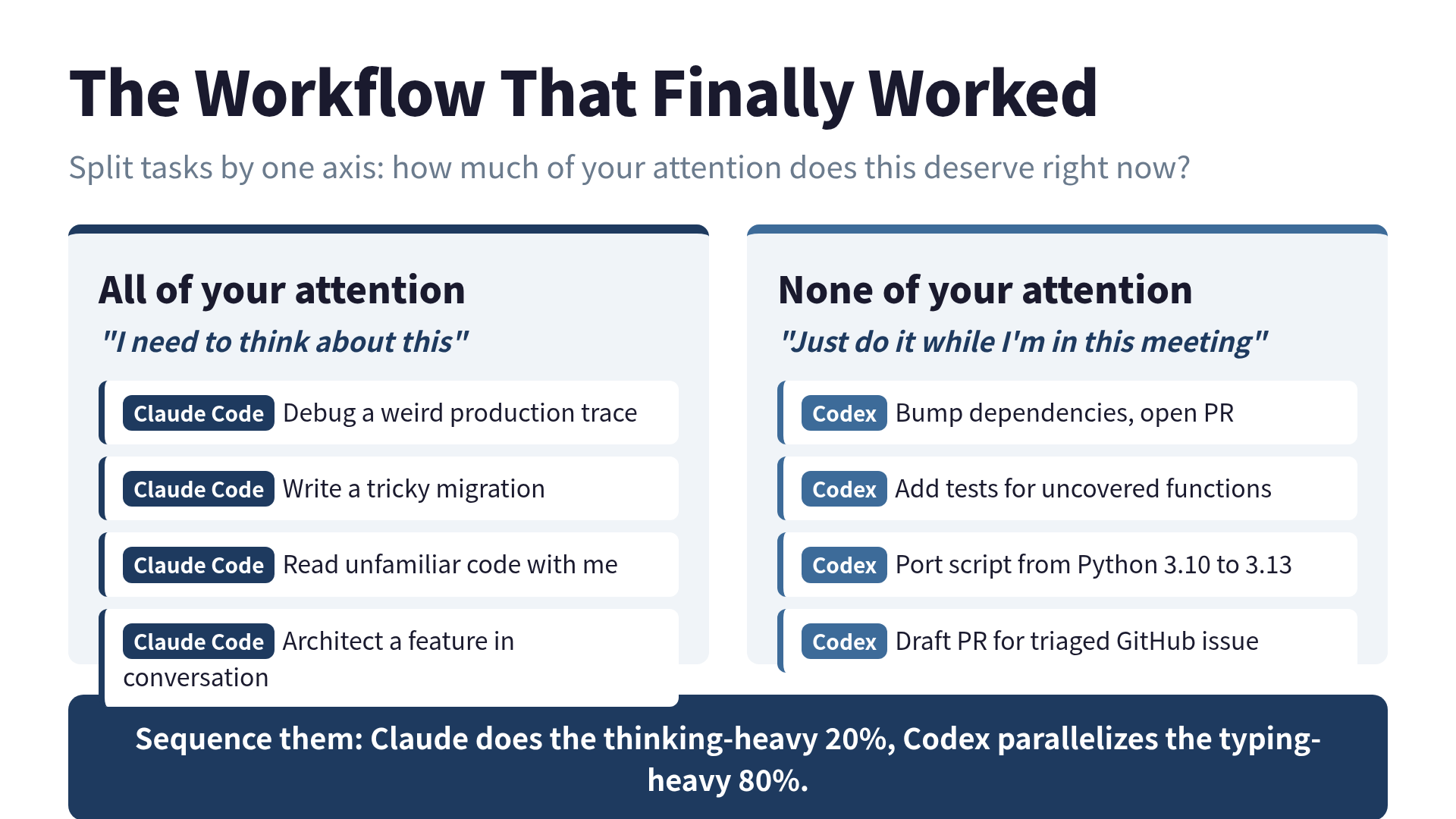
The split runs along one axis: how much of your attention does this task deserve right now?
If the answer is “all of it” (debugging a weird production trace, writing a tricky migration, figuring out a piece of code I didn’t write), Claude Code wins. The conversational loop is what you’re paying for. I want to interrupt, go “wait, why did you pick that?”, and get an answer on the spot.
If the answer is “none of it, please just do it while I’m in this meeting” (bump dependencies, add tests for the three uncovered functions, port this script from Python 3.10 to 3.13, write a draft PR for that GitHub issue I triaged yesterday), Codex wins. I write a one-paragraph spec, queue it, and review the PR an hour later on my phone.
There’s a third pattern I didn’t see coming: running them on the same task, in sequence. I’ll get Claude Code to architect a feature in conversation, walk me through the trade-offs, show me three approaches, generate a first draft. Then I hand the resulting scope to Codex with a precise spec, and let it grind through the sibling implementations. Claude handles the thinking-heavy part; Codex parallelizes the typing-heavy rest. Combined cost on Max 5x + Codex Pro comes to ~$300/mo, which sounds steep until you remember it’s roughly half a contractor’s day-rate, once a month.
A few sharp edges nobody warns you about
Four things caught me off guard in the first month.
Claude Code’s pipe mode (claude -p) is barely documented anywhere. You can pipe stdin straight into it, which means it composes with every Unix tool you already know:
git diff HEAD~1 | claude -p "review this diff for SQL injection risks"There’s your one-line code review. Codex, as far as I can tell, has no equivalent. Codex’s strong suit is GitHub PRs; Claude Code’s is being a good Unix citizen, and the pipe is a bigger deal than it looks.
Codex doesn’t see your local environment, and that turns out to be a feature. Early on I burned an embarrassing amount of time trying to figure out “why doesn’t Codex have access to my .env file?” Then it clicked that Codex is running on someone else’s computer. From then on the split was obvious: anything that needs a real local service (Docker compose, a running database, a quirky internal CLI) is Claude Code’s problem, and anything self-contained in the repo goes to Codex.
Anthropic’s third-party crackdown is real but narrower than the panic implied. The April 2026 changes mostly hit tools that piggybacked on Claude Max subscriptions to resell Claude access. The official claude CLI, the Agent SDK, and MCP integrations weren’t touched. If you’d been routing Claude through OpenClaw or a similar third-party shim, that’s what broke. Switching to the official CLI is a one-line change in most workflows.
Voice input on Codex earned its keep faster than I expected. I rolled my eyes at the feature when it launched. Then I tried walking the dog while dictating “rewrite the migrations folder to use the new naming convention, open a PR”, and the PR was waiting when I got home. That crossed a line for me. It stopped feeling like a productivity toy.
So which one should you pay for?
If you can only pay for one and want a defensible pick: start with Claude Code on the Pro plan ($20). Lower-friction entry. The conversational loop teaches you quickly what these tools are good at (and what they aren’t), and you can graduate to Max later once you start bumping into the limits.
If your workflow is “queue tasks, review PRs,” Codex is the better fit; skip straight to Plus or Pro depending on volume.
And if your honest answer is “I want both,” budget for both. Yes, you’re double-paying, but each agent covers a different job. The overlap between them is smaller than the bill implies.
The failure mode I nearly walked into is the one I’d warn people about: pick one agent, call it the winner, and try to force the wrong half of your work through it. That costs more than the subscription difference. Both companies price these things to be a rounding error against a developer’s salary, so the $100/mo is beside the point. The real cost is blowing an afternoon on a PR you should have written in chat, or babysitting a refactor the async agent could have finished overnight.
So skip the binary choice. Pick per task, and the tools sort themselves out.
Written in a workflow where Claude Code drafted this piece in conversation while Codex was queued to fix the typos in a PR. I went to make coffee. The coffee was, predictably, a mistake. The PR was fine.
Want to go deeper?
This article touches a slice. The full Claude Code playbook, covering CLAUDE.md patterns from 2 lines to 100, Plan Mode workflow, team operations, and non-coding applications, is in Practical Claude Code.
 Related book Practical Claude Code The field guide for engineers who use Claude Code every day — CLAUDE.md, Plan Mode, and team workflows from a year of real production use View the book page →
 Was this article helpful?