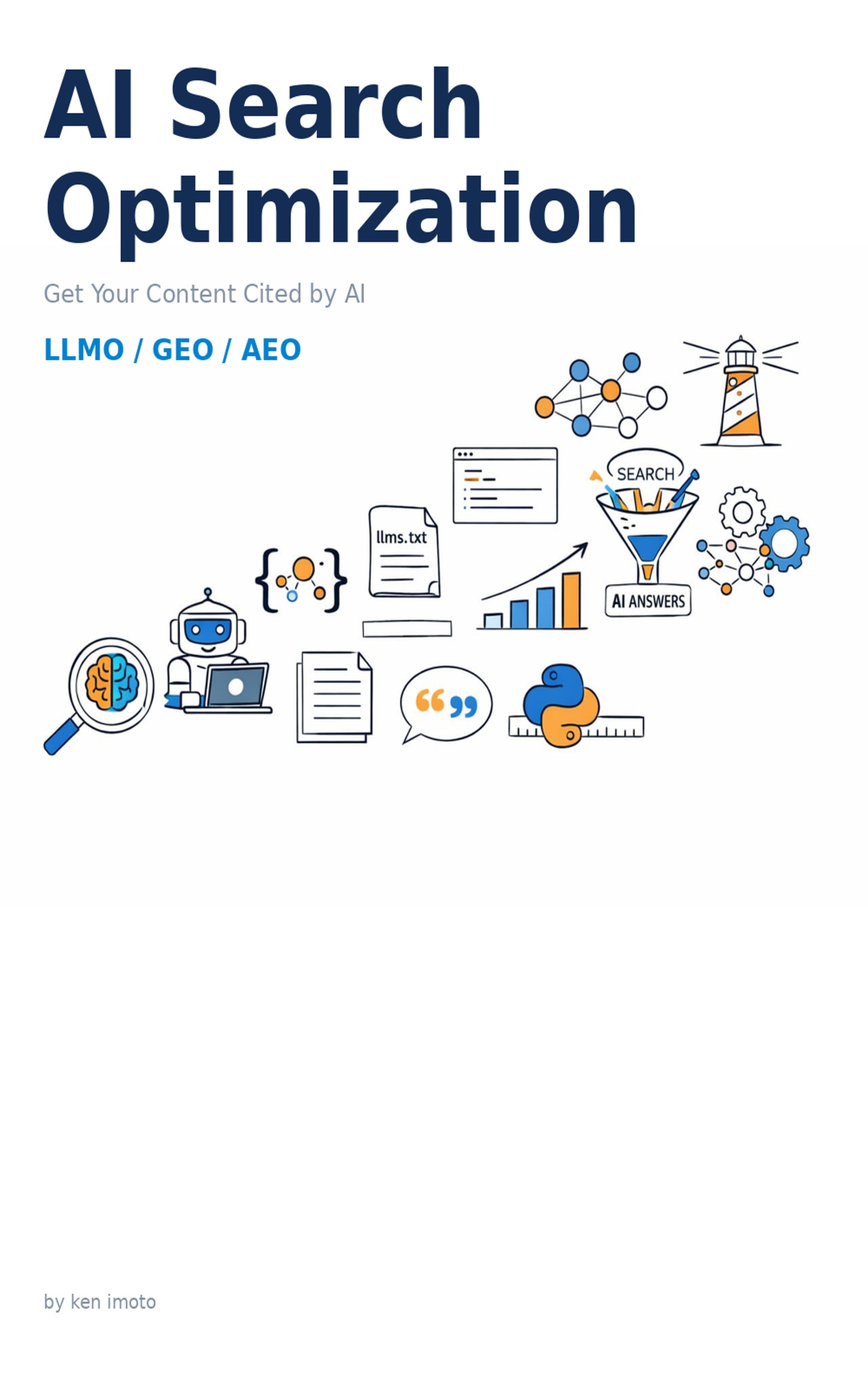
LLMO Quickstart
AI Search Optimization for Engineers
Get cited by AI search in a weekend — 8 chapters of llms.txt, JSON-LD, and citation-rate KPIs distilled from the full guide
30+ technical books across 4 languages · Sold on Kindle in 6 countries · From a year of real production use

📖 Read for free
Read three full chapters right here before you buy. Liked it? Continue on Kindle.
01 Preface
“In an era where AI gives you instant answers, is your content visible to AI?”
About This Book
This book is a getting-started guide to understanding LLMO (LLM Optimization) in the shortest time possible and beginning implementation today.
LLMO is a technique for optimizing your content to be referenced and cited in the responses of large language models like ChatGPT, Claude, Gemini, and Perplexity. It’s gaining attention as the new web optimization methodology that comes after SEO.
However, information about LLMO is still fragmented. Where should you start? How effective is it? What should engineers be doing?
I myself faced the reality that “the SEO measures I thought I was taking weren’t reaching AI at all” while working on AI search support for my technical blog and company website. This book compiles the results of systematic practice and verification from that experience.
This book answers these questions in three chapters.
Book Structure
| Chapter | Theme | Time Required |
|---|---|---|
| Chapter 1 | The Day SEO Breaks: Three Paths for AI to Find Your Content | Reading only (15 minutes) |
| Chapter 2 | LLMO You Can Implement Today: Introduction to llms.txt and Structured Data | Hands-on (1 hour) |
| Chapter 3 | Let’s Measure: Understanding LLMO Effects with Numbers | Building a System (30 minutes) |
In Chapter 1, you’ll understand “why LLMO now,” in Chapter 2 you’ll implement llms.txt and JSON-LD, and in Chapter 3 you’ll measure the effects. This flow aims to help you grasp the big picture of LLMO while having something that works in your hands when you finish reading.
Target Audience
- Engineers who know SEO but are new to LLMO
- Those who feel the changes in “AI search” but don’t know what to do
- People who want AI to find their technical blogs or OSS documentation
- Those assigned to handle AI search support for their company’s website
We assume readers can read code, but advanced programming knowledge is not required.
For Those Who Want to Learn More Deeply
This book is a quickstart guide. For those who want to dive deeper into the technical background of LLMO, detailed mechanisms of the three paths, statistical data from GEO papers, and the internal structure of Brave Search API, please see the complete guide: ‘LLMO: AI Search Optimization for Engineers’.
Now, let’s step into the world of AI search.
Continue this chapter on Kindle →02 The Day SEO Breaks — Three Paths for AI to Find Your Content
Your SEO efforts: AI isn’t watching.
Introduction: Why LLMO Now?
I’m a software engineer with 8 years of experience, currently working on AI agent development and operations. One day, I noticed that when my AI agent searched for information, it was using Brave Search, not Google.
This was shocking. The search engine I had been optimizing for with SEO measures was completely different from the search engine AI was actually using.
Upon investigation, this wasn’t just a story about my agent. Anthropic’s Claude uses Brave Search, ChatGPT uses Bing, and Gemini uses Google Search as their search backends. Different AI tools use different search infrastructure.
More importantly, user behavior itself is changing.
- 52% of American adults use AI LLMs like ChatGPT (Elon University March 2025 survey)
- Gartner predicts traditional search engine traffic will decrease by 25% by 2026 (announced February 2024)
- CTR for Google search #1 results dropped 34.5% with AI Overviews display (Ahrefs survey)
From “10 blue links” to “1 AI answer.” This change is irreversible. Once users experience “AI gives you an instant answer,” they don’t go back.
The optimization technique for this new era is LLMO (Large Language Model Optimization).
What is LLMO?
LLMO is a technique for optimizing your content to be referenced and cited in the responses of large language models like ChatGPT, Claude, Gemini, and Perplexity.
While traditional SEO aimed to “rank high on Google search result pages,” LLMO aims to “be cited as an information source in AI answers.”
Let me clarify some similar terms:
- LLMO: Large Language Model Optimization. This book uses this term.
- GEO (Generative Engine Optimization): Optimization for generative AI engines overall. Academically, this is the standard.
- AIO (AI Optimization): Optimization for AI in general. Relatively used in Japan.
- AEO (Answer Engine Optimization): Answer engine optimization. A slightly narrower concept than GEO.
All these terms essentially mean the same thing: “optimization to get your content cited in AI answers.”
SEO Doesn’t Die, But SEO Alone Isn’t Enough
Let me share something important first: SEO doesn’t die.
Google still holds about 90% search market share. However, traffic via AI is orders of magnitude higher in quality.
- LLM-sourced visitors can have conversion rates up to 23 times higher than organic search (Ahrefs survey)
- AI-sourced conversion rate is 11.4% vs organic search’s 5.3% (SimilarWeb)
- AI-sourced referral traffic increased 357% year-over-year (SimilarWeb)
Low volume but overwhelmingly high quality. This is the characteristic of AI search traffic. And this “volume” is increasing at hundreds of percent annually.
Stack LLMO on top of SEO. This is the basic strategy for information dissemination on the web from now on.
Three Paths for Information to Reach LLMs
The most important thing in understanding LLMO is “how LLMs learn about your content.” There are three main paths.
Path 1: Training Data (Long-term: 6 months to 2 years for effects)
LLMs like GPT-4 and Claude are pre-trained on massive text datasets. Information included in this training data becomes the model’s “memory.”
The important point is that not all web pages are treated equally. In GPT-3’s training data, Wikipedia and WebText2 (links from Reddit posts with 3+ upvotes) were given 5-6 times the training weight.
This means content that Reddit communities deem “valuable” is strongly etched into LLM memory.
However, training data has cutoff dates. Content published today will be reflected at the earliest in several months. That’s why this is “long-term.”
Path 2: RAG (Medium-term: 1-3 months for effects)
RAG (Retrieval-Augmented Generation) is a mechanism where LLMs perform real-time web searches to supplement information not in their “memory,” then generate answers based on retrieved information.
ChatGPT’s “Browse with Bing,” Perplexity’s web search, Google AI Overviews: these are all RAG. Citation URLs in AI answers mainly come through this RAG path.
A particularly important concept in RAG is Query Fan-out. When a user asks one question, RAG systems internally break it down into multiple sub-queries for searching.
For example, “Should startups use HubSpot?” expands into sub-queries like:
- “HubSpot startup pricing”
- “HubSpot alternatives comparison”
- “startup CRM recommendations”
SurferSEO analysis shows content ranking for sub-queries is 49% more likely to be cited than content only ranking for main queries. This means creating content structure that catches peripheral keywords like “HubSpot pricing” and “HubSpot alternatives” significantly increases the probability of being selected for AI answers.
Another important point is that LLMs evaluate content by passages (paragraphs), not entire pages. Even if an SEO #1 page has answers buried in long text, AI won’t cite it. Conversely, pages with low SEO rankings can be cited if specific paragraphs accurately answer questions.
Path 3: Real-time Search by AI Agents (Immediate: 1-3 months)
The third path is independent web searches performed by AI agents.
Microsoft’s discontinuation of external Bing Search API access in 2025 made Brave Search effectively the only choice for independent search APIs. Claude, Perplexity, and many AI coding assistants use Brave Search API.
What’s important here is that Google’s index differs from Brave’s index. Pages ranking #1 on Google sometimes can’t be found on Brave. To capture traffic via AI agents, you need to consider visibility on Brave Search as well.
Optimization Priority for the Three Paths
Which path should you start with? I recommend the following priority:
| Condition | Priority Path | Time to Effect |
|---|---|---|
| Rich existing content | Path 2 (RAG optimization) | 1-3 months |
| Planning new content | Path 2 + Path 3 | 3-6 months |
| Want to increase brand awareness | Path 1 (training data) | 6 months-2 years |
| Operating tech tools/OSS | Path 3 (agent search) | 1-3 months |
The most efficient approach is starting with Path 2 (RAG) optimization, then spreading to Paths 3 and 1. Improving content structure affects all paths.
Why Engineers Should Do LLMO
You might think “Isn’t this a marketer’s job?” No. LLMO is fundamentally an engineering problem.
- Understanding LLM architecture
- Content design considering RAG’s Query Fan-out
- JSON-LD structured data implementation
- AI crawler control via
llms.txtandrobots.txt - Python script monitoring automation
All of these belong to engineers’ skill sets.
Furthermore, we engineers are also “stakeholders” in LLMO. When doing technical research with Claude Code, comparing libraries with Perplexity, we’re AI search users. Simultaneously, when writing technical blogs or OSS documentation, we’re also AI search content providers.
Engineers with both perspectives can best understand and effectively practice LLMO.
Chapter Summary
- AI agents search with Brave Search, not Google. SEO premises are collapsing
- Three paths for information to reach LLMs: training data (long-term), RAG (medium-term), AI agent search (immediate)
- SEO doesn’t die, but SEO alone isn’t enough. Need hybrid strategy stacking LLMO on SEO
- LLMO is fundamentally an engineering problem. Technical understanding is essential
- Most efficient starting point is RAG optimization. Begin with content structure improvement
Next Actions
- Check your company website’s
robots.txtto ensure AI crawlers (GPTBot, ClaudeBot, etc.) aren’t blocked - Search your company name on ChatGPT or Perplexity to see what appears
- Check if your company website appears on Brave Search
In the next Chapter 2, I’ll explain specific LLMO techniques you can implement today: setting up llms.txt and implementing structured data (JSON-LD).
Overview
Get LLMO (AI Search Optimization) running in 30 minutes. 8 chapters distill the essentials: writing llms.txt, the minimal JSON-LD patterns, and measuring AI citation rate. The fastest path for engineers who already know SEO to start getting cited by AI.
What you will be able to do
- Understand LLMO and how it differs from Google SEO in 30 minutes
- Set up llms.txt with the minimum implementation
- Use the 3 essential JSON-LD patterns today
- Set baseline KPIs for ChatGPT / Perplexity citations
- Be ready to graduate to the full LLMO Practical Guide
Who is this book for
- [LLMO Beginner] Don't know where to start
- [Google SEO Expert] Want the next layer in the shortest path
- [Side-project Blogger] Want AI search traffic for personal sites
- [Time-poor Reader] Want 30 minutes of core, not a full book
- [Decision Maker] Need just enough to make an LLMO investment call
Problems this book solves
- Want to learn LLMO but no time for a thick book
- Just want to write llms.txt quickly
- Need the minimal JSON-LD patterns and nothing more
- Want to measure AI search traffic
- Want the overview before committing to the deep dive
Where this book stands
- Quickstart-focused (speed over depth)
- 30-minute read (8 short chapters)
- $2.99 (low entry barrier)
- Bridge to the main book (LLMO Practical Guide for the full picture)
Why this book
- Ultra-short structure: read it in 30 minutes
- $2.99 with the core distilled
- Series link with the main 'LLMO Practical Guide'
- Includes copy-pasteable implementation templates
- Focused on the minimum setup you can actually ship today
How this differs from other AI books
| Compared to | This book's difference |
|---|---|
| LLMO Practical Guide (the main book) | The main book is 18 chapters of depth. This is 8 chapters in 30 minutes — graduate to the main one when ready. |
| Google SEO books | Not an SEO extension — the fastest entry into AI-search-specific optimization. |
| AI marketing books | Not marketing theory — implementation guide for engineers. |
Table of contents
- 01 Preface — LLMO in 30 Minutes Free preview
- 1-1 About This Book
- 1-2 Book Structure
- 1-3 Target Audience
- 1-4 For Those Who Want to Learn More Deeply
- 02 What LLMO Is — vs Google SEO Free preview
- 2-1 Why LLMO Now?
- 2-2 What is LLMO?
- 2-3 SEO Doesn't Die, But SEO Alone Isn't Enough
- 2-4 Three Paths for Information to Reach LLMs
- 2-5 Optimization Priority for the Three Paths
- 2-6 Why Engineers Should Do LLMO
- 03 Minimum llms.txt Implementation
- 04 Three Essential JSON-LD Patterns
- 05 Content Structuring
- 06 Measuring AI Citation Rate
- 07 Next Steps — Toward the Main Guide
- 08 Afterword
LLMO has depth, but the first step is simple. Drop in one llms.txt file. Add three JSON-LD patterns. Measure citations. That alone moves the needle.
This book is just those first 30 minutes. When you want to go deeper, the main “LLMO Practical Guide” picks up where this stops.
“The shortest path starts from a copy-pasteable template.”
Related books


FAQ
- How is this different from the full LLMO guide?
- This is the 30-minute starter: 8 chapters covering llms.txt, the minimal JSON-LD patterns, and baseline citation KPIs. The full LLMO Practical Guide goes deeper on strategy and measurement.
- What will I actually implement?
- A working llms.txt, the 3 essential JSON-LD patterns, and a baseline for measuring ChatGPT and Perplexity citations, all from the first read-through.
- Where can I buy it?
- The English edition is on Amazon Kindle. Japanese and Portuguese editions are also available.
Read on Kindle
Included in Kindle Unlimited
Read on Kindle* This page contains Amazon Associates links. Purchases may earn the author a referral fee.