OSS · Python CLI + MCP
rag-db-advisor
Find the right vector database for your RAG workload, with the evidence attached.
"Which vector DB?" answers are usually made of opinions. This one is made of measurements: ask which backend fits your workload, what a latency number actually means or which trap you are about to step on, and it answers from 54 evidence chunks distilled from 9 benchmarked configurations. The advisor returns evidence; your LLM writes the answer.
Instead of choosing by popularity, choose by your workload.
Try it on GitHub How it decides what to say →
Free · Open Source · an evidence-backed answer in seconds
- 4.3 s measured answer time
- ~2 min setup to first answer
- 54 evidence chunks
- Free Open Source · MIT
- Answers you can trace 54 chunks, each traceable to a bench record or a reproduced trap
- Comparison on demand 9 configurations × 10k / 100k passages, 860 annotated queries
- Traps before you hit them 3 silent-degradation cases, reproduced before written down
- Runs inside Claude Code 3 MCP tools, no generation key on the server

Three steps
- Ask
rag-db-advisor ask "…"One free-form question, over CLI or MCP. No questionnaire to fill. - Evidence comes back
=== note:qdrant#1 (knowledge/ja/qdrant.md) ===Chunks with measured numbers, each headed by its chunk ID and source record. - You decide
--llm / your LLM over MCPSynthesis happens outside: your LLM (or you) writes the verdict, sources attached.
Example: a real answer
rag-db-advisor ask "Building RAG search over 100k Japanese documents. Recall must hold, operations should stay light. Which vector DB?" --llm
✓ Recommended Qdrant (HNSW)
- recall@10 0.947 at 100k · top ANN config, 0.5 pt under the 0.952 exact-search ceiling
- search p50 3.3 ms · same corpus, same embeddings as every other candidate
- LanceDB ruled out · default quantization drops recall to 0.811
Weighed against: LanceDB (recall@10 0.811 at 100k, built-in quantization)
real run, 2026-07-12: rag-db-advisor ask --llm --model gpt-4o, condensed from the Japanese original
What the evidence can weigh
Every axis below is covered by measurements or reproduced traps, the only two things allowed into the store:
- Dataset size measured at 10k and 100k passages
- Retrieval quality recall@10, nDCG, MRR, hit@k vs human ground truth
- Latency p50 / p95 / p99 per query
- Write path bulk-load + index-build seconds
- Operational traps 3 reproduced cases, machine-checked
- Deployment shape embedded vs server, separate tables
Metadata filtering, hybrid search and cost estimates sit outside the v0.1 evidence, so the advisor errors instead of improvising on them. The measured scope is honest about its own edges.
Who it’s for
- AI engineers who need a citable number for "why this database" in a design doc
- RAG developers debugging "search feels slow" and wanting the known traps ruled out first
- Claude Code users who want RAG-stack answers grounded in evidence instead of model priors
- Tech leads reviewing a vector-DB proposal and checking what the numbers actually mean
When to reach for it
- Before picking a database for a new RAG feature: start from same-conditions measurements instead of vendor material
- When ClickHouse vector search "feels slow": the reproduced trap catalog exists exactly for that impression
- When a review asks "why Qdrant?": answer with evidence blocks that carry their source record IDs
- Mid-implementation in Claude Code: your LLM pulls the evidence over MCP without leaving the session
Install
pip install git+https://github.com/kenimo49/rag-db-advisor
export OPENAI_API_KEY=sk-...
rag-db-advisor ingest
The API key is used for embeddings only (text-embedding-3-small). Over MCP no generation key is needed server-side: the server returns evidence and your LLM writes the answer.
What it knows
- Measurement records: 9 backend configurations × 2 corpus scales (10k / 100k MIRACL-ja passages, 860 human-annotated queries), each record carrying quality, latency, ingestion and index-verification evidence
- Operational notes: 8 hand-written files, one per backend plus cross-cutting principles, covering only behavior reproduced during the bench work
- A trap catalog: 3 ways a backend degrades with zero errors raised, each one reproduced, fixed and written down
- Methodology caveats baked into answers: embedded vs server latency is not directly comparable, and the numbers are MIRACL-ja + text-embedding-3-small on a single node
- 3 MCP tools: advise (evidence retrieval), compare_backends (10k / 100k comparison table), list_traps (per-backend traps). Failures return {"error", "hint"} instead of raising
The trap catalog, sampled
Three of the seven backends shipped a way to degrade with zero errors raised. All three were hit during the bench work, reproduced, and only then written into the knowledge base:
| Backend | What happens | What you see | Machine check |
|---|---|---|---|
| ClickHouse | Forget the allow_experimental_vector_similarity_index flag at query time and HNSW silently becomes brute force | "HNSW" at 27 ms vs brute force at 31 ms: almost the same | EXPLAIN indexes=1 shows whether the skip index ran |
| Qdrant | Segments under 20 MB are not HNSW-indexed by default (indexing_threshold) | Status green, indexed_vectors_count = 0, every query full-scans | Assert indexed_vectors_count == points_count |
| Milvus | The quick-setup path silently drops index_params and builds AUTOINDEX | You specified HNSW; describe_index says AUTOINDEX | Check index_type via describe_index after creation |
source: knowledge/ja/clickhouse.md · qdrant.md · milvus.md (reproduced before written down)
Advice the evidence actually changes
Two examples of answers that flip once you look at measurements instead of datasheets:
Default quantization
recall@10 0.983 → 0.901
Same 10k corpus, same embeddings: the best plain-HNSW configuration vs LanceDB IVF_HNSW_SQ, whose built-in quantization costs 8 recall points (19 at 100k). Read "does quantization kick in", not "does it say HNSW".
source: knowledge/ja/lancedb.md, cross-cutting.md
The planner, not the index
2,048 rows: seq scan · 4,096 rows: index scan
pgvector builds your HNSW index, then the Postgres planner ignores it below a few thousand rows (measured at ef_search=100). Small-scale "HNSW feels slow" verdicts are often this.
source: knowledge/ja/pgvector.md
Usage
# evidence only
rag-db-advisor ask "pgvector or Qdrant for 100k Japanese docs?"

# + OpenAI synthesis (default model: gpt-4o-mini)
rag-db-advisor ask "ClickHouse vector search feels slow. What should I check?" --llm

# register as an MCP server in Claude Code
claude mcp add rag-db-advisor -- rag-db-advisor mcp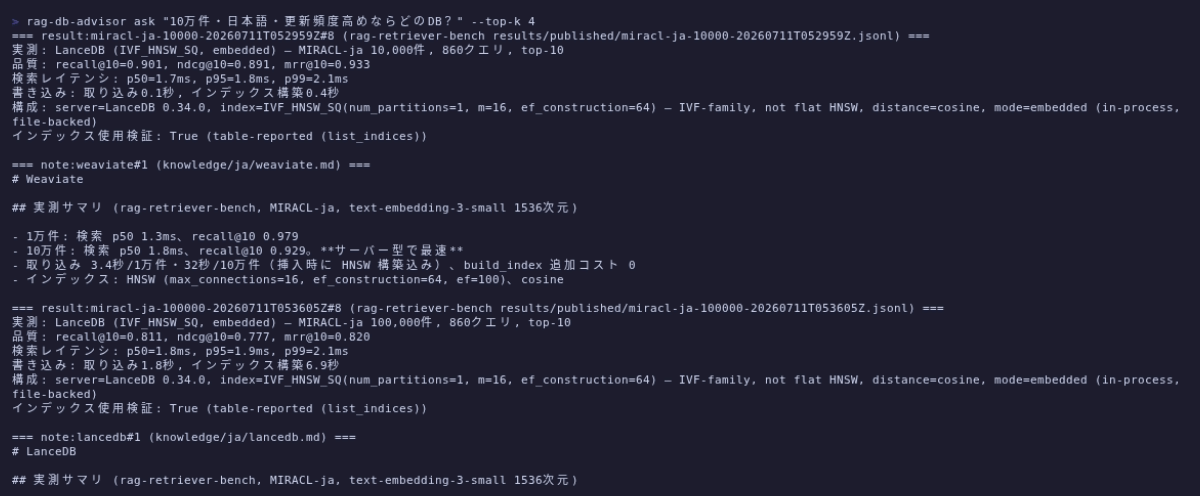
Refusing is a feature
The failure mode this tool is built against: the retrieval layer breaks, the calling LLM silently answers from prior knowledge, and nobody notices. So the advisor fails closed:
- Retrieval failures return an explicit {"error", "hint"} across all three MCP tools; exceptions are never swallowed into prose
- An empty result set is also an error, not a null answer: the calling model sees "no evidence" instead of "no problem, let me guess"
- No verdicts are generated inside: the advisor retrieves, your LLM (or you) synthesizes, and the sources stay attached
Every chunk traces back to a bundled bench record (knowledge/results/*.jsonl) or a hand-written note about reproduced behavior (knowledge/ja/*.md). Speculative advice is out of scope by policy.
Dogfooding: the retrieval layer imports rag-retriever-bench’s own BaseRetriever abstraction and stores its knowledge in Chroma, because the bench data shows every plain-HNSW backend is quality-tied at this corpus size. The advisor follows its own advice.
Why this tool exists
While building rag-retriever-bench, the numbers turned out to be the durable part: they land in JSONL and reports and stay there. What kept evaporating was the operational knowledge around them: the flag that silently disables an index, the threshold that leaves a collection unindexed behind a green status. Opinions about databases do not reproduce; measurements and reproduced traps do. So this advisor closes the loop: measure, distill what was measured and hit into a knowledge base, and serve it to the next question. And when it has no evidence, it says so instead of guessing.
Alongside an LLM chat and ann-benchmarks
Different tools answer "which vector DB?" differently. The honest difference is where the answer comes from:
| rag-db-advisor | Asking an LLM directly | ann-benchmarks | |
|---|---|---|---|
| Answer based on | Bundled measurements + reproduced traps | Model priors; sources not traceable | Public ANN benchmark runs |
| Scope | RAG retrieval backends on a Japanese text corpus (MIRACL-ja) | Anything | ANN algorithms and engines on standard feature datasets (glove, sift, etc.) |
| Operational traps | ✓ 3 reproduced cases with machine checks | — | — |
| When evidence is missing | Explicit error (fail-closed) | Answers anyway | — |
| How you use it | MCP tools + CLI | Chat | Web charts |
A dash means the option does not cover that axis, not that it is worse: an LLM chat is broader and ann-benchmarks is the reference for raw ANN performance. This advisor is deliberately narrow: one corpus family, one embedding model, and every claim traceable to a record.
FAQ
Do I need an OpenAI API key?
Yes, for embeddings only (text-embedding-3-small): queries and chunks are embedded through the OpenAI API. Over MCP the server needs no generation key: your LLM writes the answer. The optional --llm flag adds OpenAI synthesis (gpt-4o-mini by default).
Is my question sent anywhere?
The question text goes to the OpenAI embeddings API to be embedded; the knowledge base itself is local (Chroma, on disk). With --llm the question and evidence also go to the OpenAI chat API for synthesis. Over MCP, synthesis happens in whatever LLM you already use.
Can I ask in English?
Retrieval works across languages since it runs on embedding similarity, but the knowledge base itself is written in Japanese, both the notes and the rendered records. Over MCP your LLM translates the evidence when it writes the answer. Native English knowledge is not bundled in v0.1.
How much evidence is inside, exactly?
54 chunks in v0.1: 18 measurement records (9 backend configurations × 2 corpus scales from rag-retriever-bench) plus 36 chunks from 8 hand-written operational notes. If it wasn’t measured or actually hit, it isn’t in there.
Can I just follow its advice for my workload?
Treat it as a measured starting point, not a verdict: the numbers are MIRACL-ja + text-embedding-3-small on a single node, and the answers carry that caveat themselves. For your own corpus and infrastructure, run rag-retriever-bench: that is exactly what it is for.
What happens when there is no evidence for my question?
You get an explicit error, not a guess. All three MCP tools return {"error", "hint"} on failure, and an empty result set is treated as an error too, so the calling LLM cannot silently fall back to prior knowledge.
Can I add my own knowledge?
Yes: docs/adding-knowledge.md describes the format for notes and measurement records. The house policy still applies: write down only behavior you measured or reproduced.
Why does it not generate the answer itself?
Reproducibility. If the advisor ran its own LLM, the same question could get different verdicts between runs. By returning deterministic evidence and leaving synthesis to the calling LLM, the numbers only change when the bench is re-run, and every claim keeps its source attached.
About the author
Built by Ken Imoto: 300+ technical articles across Zenn, Qiita, Dev.to and this site, 40+ books in 4 languages, 400K+ pageviews on Zenn and Qiita, 4 research papers on Zenodo, and creator of the LLMO Framework.
Related
All evidence comes from rag-retriever-bench, the benchmark harness that measures the same corpus and queries across 9 backend configurations.
Related developer tools
- hook-chain-lens A read-only CLI that reads every Claude Code hook scope (user, project, local, plugin) and prints what will actually fire in this cwd, in what order, from where.
- private-lint Git-hook gate that blocks personal and private names (family names, personal emails, client domains) before commit and push. Pure Bash; detection patterns stay machine-local, never in any repo, and a full-history audit covers the moment before you flip a repository public.
- quake-lens Earthquake statistics CLI + MCP server in pure-stdlib Python: Gutenberg-Richter b-value (Aki MLE) and Omori-Utsu aftershock decay (Ogata MLE) from public catalogs.
- rhythm-lens Measures the rhythm of Japanese, English and Portuguese Markdown (sentence-length burstiness, paragraph structure) against measured human/AI distributions from two published papers. A writing feedback instrument, not an AI detector.