Your Page Rank Is Invisible to AI — Only Your Passages Get Cited
I spent two years chasing page-one rankings. Then I watched an AI assistant cite a post of mine that was sitting on page three of Google, and ignore the post that was ranking number one for the exact same query. That stung. It also told me everything I’d been optimizing for was aimed at the wrong unit.
Here’s the thing nobody told me clearly enough: AI search doesn’t cite pages. It cites passages.
The unit changed and nobody sent a memo
Classic SEO has one atomic unit — the page. You rank a URL, the whole URL goes up or down, and your job is to drag that URL toward the top. Simple mental model, even if the work is brutal.
AI search quietly threw that model out. When ChatGPT Search, Perplexity, or Google’s AI Overviews answer a question, they don’t hand the user a list of ten blue links. They assemble an answer, and they pull the building blocks of that answer from specific paragraphs — passages — scattered across many sources.
This is why my page-three post got cited. One paragraph in it answered the user’s sub-question cleanly. The number-one page didn’t have a paragraph like that; it had 2,000 words of warm-up before it said anything quotable. Google rewarded the marathon. The AI wanted a single clean sentence, and my also-ran had one.
Research keeps backing this up: a large share of AI Overview citations come from sources that aren’t in the top ten organic results at all. Your page rank and your citation odds are only loosely related. So if you’re still optimizing the page as a monolith, you’re polishing a unit the AI never looks at.
What “snappable” actually means
A snappable passage is one an AI can lift out, drop into an answer, and have it still make sense with zero surrounding context. That last part is the whole game.
Test it yourself. Take any paragraph from your latest post, paste it into a blank document, and read it cold. Does it stand on its own? Or does it lean on the three paragraphs above it with words like “this,” “therefore,” and “as mentioned”? If it can’t survive being copy-pasted out of context, an AI won’t lift it — because the AI is, functionally, copy-pasting it out of context.
Most of my old writing failed this test spectacularly. Every paragraph was a passenger on the paragraph before it. Great for a human reading top to bottom. Useless for a machine grabbing one row out of the middle.
The four-layer structure I now write to
After the page-three humiliation, I rebuilt how I draft. I think about content in four layers now, smallest to largest:
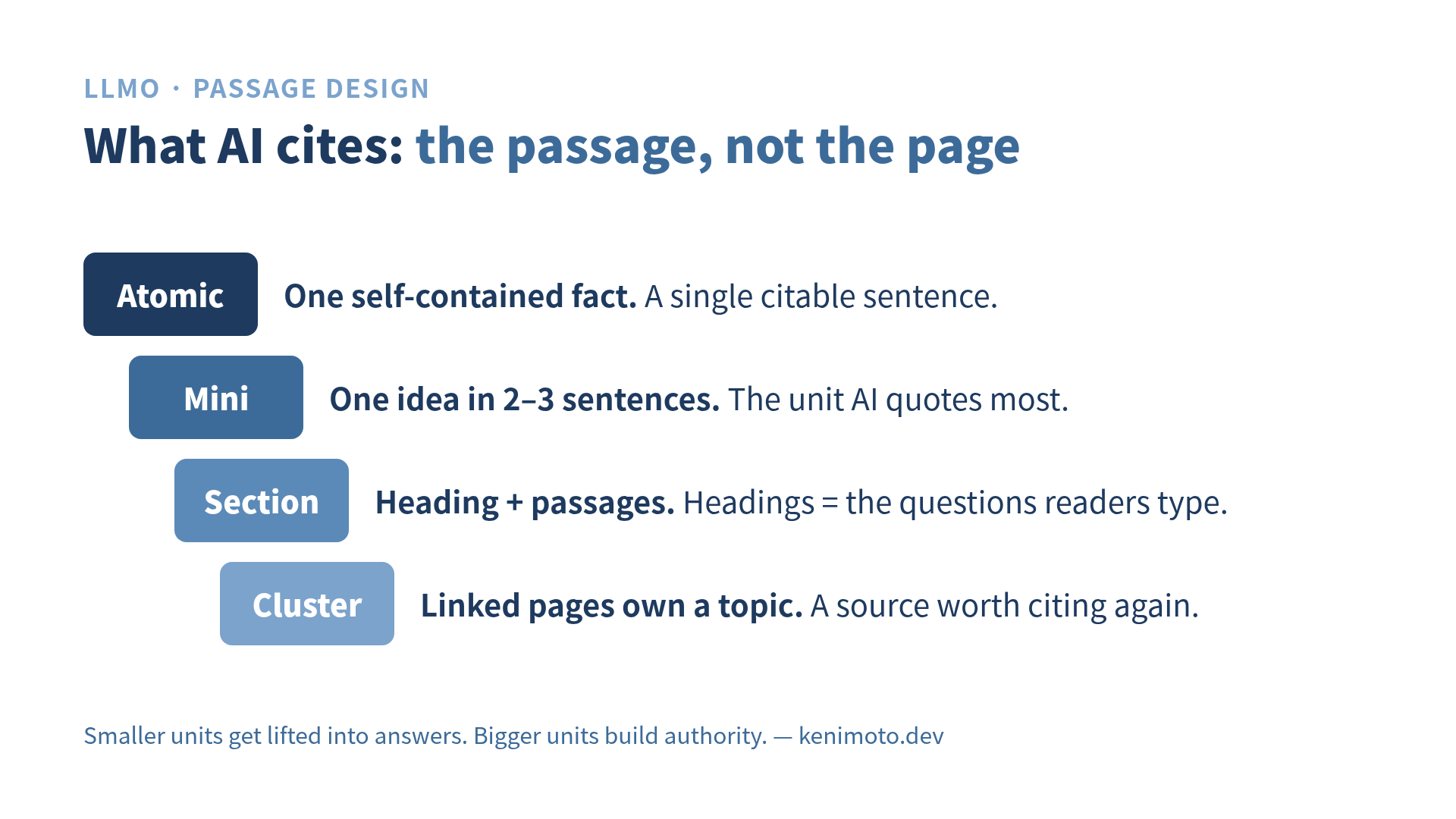
Atomic — one self-contained fact. A single sentence that states something true and citable without any setup. “TypeScript was released by Microsoft in 2012.” Not “our solution has helped many teams.” The AI wants facts it can stand behind, and vague reassurance isn’t a fact.
Mini — one idea in two or three sentences. Enough to define a concept and its consequence, no more. This is the unit AI assistants quote most often in my experience, because it’s a complete thought that still fits in an answer box.
Section — a heading plus its passages. The heading is doing retrieval work, not decoration. Write headings as the questions your reader actually types, and you’ve handed the AI a labeled drawer to reach into.
Cluster — related pages that own a topic. No single page covers a domain. A set of tightly linked pages signals that you’re a source worth citing repeatedly, not a one-off.
The shift in practice is small but relentless: I stopped writing paragraphs that depend on their neighbors, and started writing paragraphs that could be kidnapped.
Answer first, throat-clearing never
The other habit I had to kill was the warm-up. I used to open every section with context, build tension, and reveal the answer at the end like a magician. AI search hates magicians. It wants the rabbit on the table in sentence one.
So I flipped to answer-first — close to old-school PREP (Point, Reason, Example, Point). State the conclusion, then justify it. If someone asks “should I use passage optimization,” the first sentence is “Yes, because AI cites paragraphs, not pages,” and the explanation follows. The AI can grab that opener and move on; the human who wants depth keeps reading. Everybody wins, and nobody waits for the reveal.
Question-and-answer blocks work even harder. A literal question as a heading, followed by a tight two-sentence answer, is about the most liftable structure there is. It mirrors exactly what the user asked the AI, so the match is almost too easy.
Numbers are bait, and AI bites
Here’s a pattern I noticed and then found research for: passages with concrete numbers get cited far more than passages with adjectives. The Princeton-led study on generative engine optimization found that adding statistics, citations, and quotations lifted a source’s visibility in AI answers by up to 40%. That’s not a rounding error. That’s the difference between being the cited source and being the source nobody saw.
So I went back through my drafts and turned soft claims into hard ones. “Schema markup can meaningfully boost AI visibility” became a specific case: Sharp HealthCare reported an 843% increase in AI-driven clicks over nine months after a structured-data overhaul. One of those sentences is forgettable. The other is a quote waiting to happen.
The chapter I pulled this framework from cites more in the same direction — meaningful citation lifts from optimizing for sub-queries and from adding statistics to otherwise-plain passages. I’d treat the exact percentages as directional rather than gospel, since methodologies vary, but the direction is consistent everywhere I’ve looked: specificity gets cited, vagueness gets skipped.
Structured data is the passage’s name tag
Passages get you cited; structured data makes you legible. Schema markup (JSON-LD) tells the machine what each chunk of your page actually is — this is a question, this is its answer, this is the author, this is the publish date. Perplexity’s own behavior shows a visibility bump for content with clean structured data, and Brave’s LLM-context tooling can extract down to the table-row level when the markup is there to guide it.
Think of it this way: a great passage with no schema is a brilliant answer written on an unlabeled scrap of paper. The schema is the label that lets the machine file it correctly and find it again.
Freshness is a passage property too
One more lever I underrated: recency. AI systems lean toward fresh sources, and the gap is bigger than I expected — citation frequency can differ by tens of percent between content updated hours ago versus content a month stale. Adobe’s guidance lands around refreshing key content every few weeks. So now I don’t just write a passage and abandon it. I revisit the high-value ones, update the numbers, and bump the date. A passage isn’t a monument; it’s a houseplant.
What I actually do now
When I draft a post today, the checklist is short and a little ruthless:
- Can each paragraph be lifted out and still make sense? If no, rewrite it.
- Does every section lead with its answer? If no, move the answer up.
- Are the claims specific and numbered? If no, find the number.
- Is the structure machine-legible via schema? If no, add it.
- Are the high-value passages fresh? If no, update them.
I still care about traditional rankings — they haven’t vanished. But I stopped treating the page as the thing I’m optimizing. The page is just a container. The passages are the product. And the day I started writing for the paragraph instead of the URL was the day AI assistants started quoting me back to people I’ll never meet.
For a fuller breakdown of AI-extractable content structure, the llmoframework.com content-design notes cover the passage and structured-data layers in more depth — I keep the canonical version of this thinking there and here.
If you want the full system — the four layers, the structured-data patterns, and the measurement loop behind all of this — I wrote it up in LLMO: AI Search Optimization.
Was this article helpful?