I Gave Every Page on My Site a .md Twin. The AI Fetchers Stopped Guessing
A while back I added an llms.txt to my site because everyone said I should. One Markdown file at the root, a tidy table of contents for the robots, a little hopeful note that said “dear AI, here is my site, please be kind.” Then I checked my logs a month later and the citation-driving crawlers had touched it almost zero times. I had written a letter and mailed it to a house nobody lived in.
Around the same time, Google’s Gary Illyes confirmed at Search Central Live that Google does not support llms.txt and has no plans to. John Mueller went further and compared it to the keywords meta tag: a thing site owners controlled, therefore a thing search engines learned to ignore. That comparison stung, because it was correct.
So I stopped trying to summarize my whole site in one file the robots don’t read. I did the opposite. I gave every single page its own Markdown twin, served at the same URL with .md glued on the end. And that one actually moved the needle.
The pattern in one line
Take any page. Append .md. Get the same content as clean Markdown instead of HTML.
/company       → HTML for humans
/company.md    → Markdown for machines
That’s it. Same URL, same content, two costumes. A human hits /company and gets the full styled page with the nav bar, the cookie banner, the footer with my forty social links. An AI fetcher hits /company.md and gets the actual words, in Markdown, with none of the furniture.
The idea isn’t mine. It’s the logical extension of what Jeremy Howard proposed with llms.txt back in September 2024, except that instead of one summary file describing the site, you push the same “give them Markdown” thinking down to every page. And it turns out the people building the tools already do this. Anthropic’s own docs serve it: take any page like docs.claude.com/en/docs/claude-code/plugins, slap .md on it, and you get the raw Markdown the rendered page was built from. Once I noticed that, I felt a little silly. The model providers are feeding their own crawlers clean Markdown, and I was out here making mine eat a div soup.
Why HTML is a bad meal for a robot
When a crawler fetches your HTML page, it has to do surgery. Strip the <nav>. Strip the cookie consent. Figure out which <div> is content and which is a sidebar ad. Throw away the SVG icons, the analytics blob, the third-party widget that loads your “related posts.” Only then does it have something resembling your actual writing, and it spent tokens and guesses getting there.
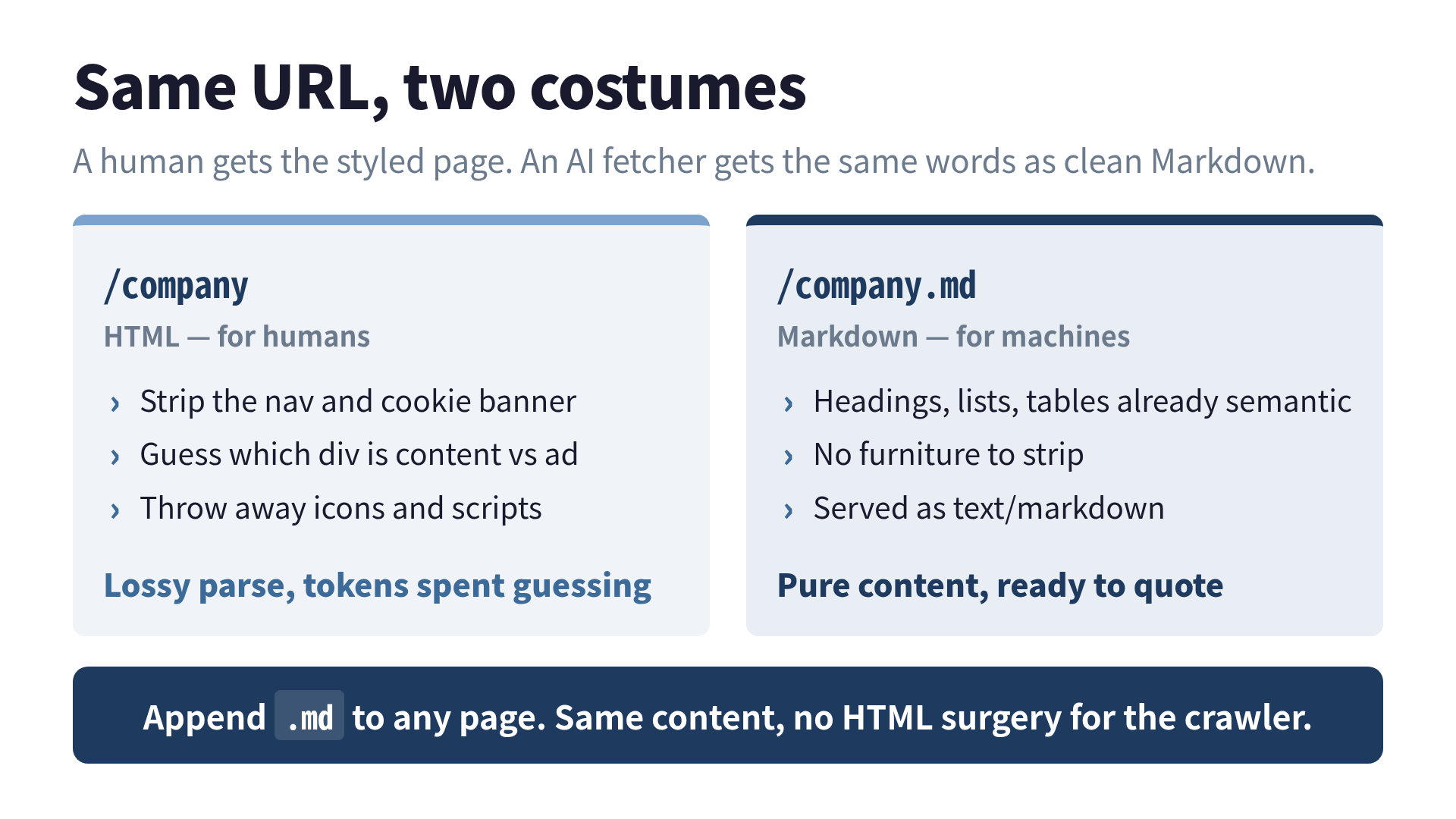
Markdown skips all of that. There’s no nav to strip because you never put one in the .md. The structure (headings, lists, tables) is already semantic, already the thing a model wants. You’re not asking the crawler to reverse-engineer your content out of your layout. You’re just handing it the content.
Now, I want to be honest about the evidence here, because the LLMO space is full of people selling certainty they don’t have. Do crawlers officially prefer Markdown? The big providers haven’t published a guarantee. The “agents prefer the .md variant” claim is industry consensus, repeated in a hundred dev blogs, and not confirmed in writing by OpenAI or Anthropic. So treat it as a strong bet, not a law. But here’s the part that is solid: a live agent fetching /company.md provably gets cleaner input than one parsing /company, for the same reason a sandwich is easier to eat than the ingredients plus the grocery bag. The mechanism is real even where the vendor confirmation is missing.
The Astro implementation
My site runs on Astro, where any .ts file under src/pages becomes a route. So /company.md is just a file called company.md.ts. Here’s the shape of it:
import type { APIRoute } from 'astro';

export const GET: APIRoute = () => {
  const body = `# My Company — Overview

## Basics
| Field | Value |
|-------|-------|
| Name | Example Tech |
| Founded | 2025 |

## Mission
The one-paragraph version, in plain Markdown.
`;

  return new Response(body, {
    headers: { 'Content-Type': 'text/markdown; charset=utf-8' },
  });
};
The header is the part people get wrong. It has to be text/markdown, not text/plain. Serve it as plain text and you’ve told the machine “this is a wall of characters” instead of “this is structured Markdown” — you did the work and then hid the receipt. The charset=utf-8 matters too the moment you have a single non-ASCII character, which, given my name, is always.
For the truly thorough version, the current best-practice writeup I keep going back to is nibzard’s “Serve Markdown to Agents” (May 2026), which layers content negotiation on top: inspect the Accept header, fall back to User-Agent sniffing, and use sec-fetch-dest to tell a real browser apart from an agent. You can also advertise the twin with a Link: <…/company.md>; rel="alternate"; type="text/markdown" header so a crawler discovers it without guessing the URL scheme. I started with the dumb .md.ts files and added negotiation later. Start dumb. It works dumb.
The one gotcha that cost me an evening
If you host on GitHub Pages like a lot of static sites do, there’s a trap. GitHub Pages runs your .md files through Jekyll, which compiles them to HTML. So you drop a company.md in your repo expecting raw Markdown, and the server hands visitors a rendered HTML page instead — the exact thing you were trying to avoid, now wearing a .md URL as a disguise. The fix is to generate the .md as a real static asset Jekyll won’t touch (Astro’s build does this for you), and then (this is the part I skipped and regretted) actually verify it:
curl -I https://yoursite.com/company.md
# you want: Content-Type: text/markdown; charset=utf-8
# not:      Content-Type: text/html
I assumed mine was fine for two weeks. It was serving text/html. Two weeks of confidently shipping the wrong thing, undone by one curl -I I should have run on day one.
Where this sits in the bigger LLMO picture
I don’t want to oversell a file-naming trick as a growth strategy. The .md twin is one signal among several. It sits in the “structural formatting” and “retrieval signals” bucket of the framework over at llmoframework.com, which breaks LLMO into six components (knowledge clarity, structure, retrieval, authority, citation, coherence). The .md twin makes your content easy to ingest; it does nothing for authority or whether anyone wants to cite you in the first place. A clean Markdown page about a topic nobody trusts you on is still a clean page nobody quotes.
But of the six, this one is the cheapest to ship and the hardest to argue against. The skepticism aimed at llms.txt (that it’s a self-declared summary the robots ignore) doesn’t land here, because the .md twin isn’t a claim about your site. It’s the actual content, fetched live at the moment an agent needs it. There’s nothing to distrust. It’s just the same words, served politely.
What I’d tell past me
If you have a static site and twenty minutes: pick your five most-cited pages, give each one a .md twin with the right Content-Type, curl -I to confirm, and link them from your llms.txt so there’s at least a trail. Don’t bother summarizing your whole site for crawlers that won’t read the summary. Hand them the pages instead.
I spent a month writing a letter to an empty house. Then I just left the door open on every room. Turns out that’s all anyone wanted.
If you want the full playbook that goes past the .md twin into JSON-LD, robots strategy, content design, and measuring whether AI actually cites you, I wrote a field guide for exactly that: Why ChatGPT Ignores Your Website.
 Related book Why ChatGPT Ignores Your Website Google SEO won't get you cited by ChatGPT — this is the playbook for being seen by AI search, with measurement included View the book page →
 Was this article helpful?