Harness Engineering Benchmark: 13.7pt Same Model
I used to think a bad agent was a prompting problem. Rewrite the system prompt, add a few-shot, maybe apologize to Claude. Done.
Then LangChain published a number that ruined that reflex.
The delta that ended my prompt-tuning career
LangChain took their coding agent on Terminal-Bench 2.0, kept the model, and improved the scaffolding around it. Same weights on the way in. Same weights on the way out.
Score went from 52.8% to 66.5%. That’s 13.7 percentage points, and it moved them from around rank 30 to the Top 5 on the same leaderboard.
The write-up on the LangChain blog is worth reading end-to-end. LangChain groups the work into three levers — system prompt, tools, and middleware — and the middleware and tooling changes did the heavy lifting. Even the system-prompt work is closer to structural scaffolding (“plan / build / verify / fix”) than to the “just reword it” prompt tweaking most of us mean by prompt engineering.
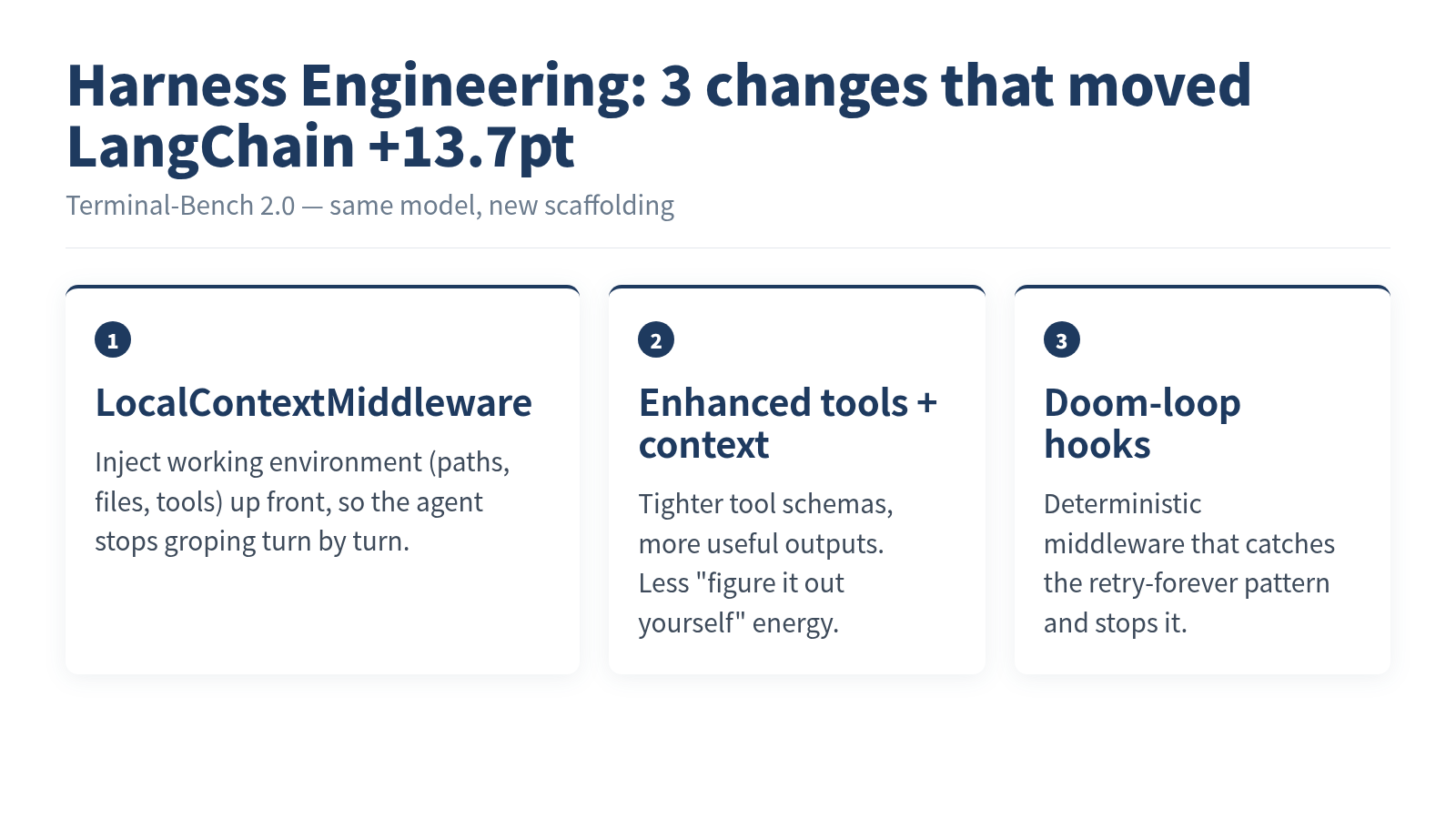
Three specific pieces stood out to me:
- LocalContextMiddleware — inject the working environment (paths, existing files, tool inventory) up front, instead of letting the agent grope for it turn by turn.
- Enhanced tools and context injection — tighter tool schemas, more useful outputs, less “figure it out yourself” energy.
- Loop-detection middleware that catches doom loops — a small, deterministic thing that watches for the retry-forever pattern and nudges the agent to reconsider its approach.
That’s all plumbing. And it moved the number further than any prompt swap I ever ran.
Why the industry stopped calling it “prompt engineering”
The vocabulary shifted for a reason. In 2026 there are three layers people mean when they say “how I built my agent,” and they don’t compress into each other.
- Prompt engineering — what you literally tell the model this turn.
- Context engineering — what appears in the context window at every step (system prompt + retrieved docs + memory + tool defs + prior turns). Includes prompts, but is broader.
- Harness engineering — the deterministic software wrapped around the model: orchestration, retries, verifiers, hooks, security boundaries, observability. Includes context engineering, but is broader.
The LangChain result lives at the harness layer. Same prompt, tighter scaffolding around it.
If you’re benchmarking your agent and blaming the model, there’s a nonzero chance you’re diagnosing the wrong layer. That’s what I did for a whole quarter.
The six modules that make a harness
The clearest breakdown I’ve seen is from Next Signal Prediction’s “Decode the Buzzword” essay, which splits the harness into six things:
| Module | What it does | Example |
|---|---|---|
| Information management | Decides what the agent knows | CLAUDE.md, RAG, skills, memory |
| Execution drive | Decides how the work runs | Task split, orchestration, retries, timeouts |
| Quality verification | Checks the output | Linter, type check, tests, LLM judge |
| Tracing / observability | Records what happened | Logs, tokens, timings, LangSmith |
| Security boundary | Decides what’s allowed | allowedTools, sandbox, approval gates |
| Tool definition | Gives it capability | Function schemas, MCP, file ops |
Look at LangChain’s three fixes with that grid in your head:
- LocalContextMiddleware → information management.
- Enhanced tools & context injection → tool definition + information management.
- Loop-detection middleware → execution drive + tracing (you need to see the loop before you can catch it).
Three fixes, four modules touched. The prompt work that did happen was structural — laying out phases the agent has to walk through — not a reworded instruction.
What I actually changed on my side
I run a three-agent harness at home (observer → strategist → marketer) for my own site. Before I read the LangChain post I was trying to squeeze quality out of the marketer’s system prompt. After, I moved the effort to the boring parts:
- Wrote a
verify/directory of pass/fail scripts. If a script fails, the marketer halts. No apology, no retry. - Added a hook that watches the tail of the trace for the same tool call repeated 4+ times. That’s the doom loop signature. Kill it, dump state, notify me.
- Front-loaded the “here’s what exists” context. Filenames, tags in use, sponsor IDs. The marketer no longer greps 40 times to figure out what folder it’s in.
I did not get +13.7pt. I don’t run Terminal-Bench and I don’t have LangSmith at scale. But my “articles-that-pass-QC-first-try” rate went from something embarrassing to something I don’t mind admitting in public.
Same mechanism at work: shrink the model’s blast radius, and disasters shrink with it.
The uncomfortable implication
If harness changes can move a benchmark by 13.7 points on the same model, then a lot of “my agent isn’t good enough, I need GPT-6” is misdiagnosed.
Usually the bottleneck lives in the scaffolding around the model, and the scaffolding is something you actually control. Claude’s weights are frozen; the middleware you can rewrite in an afternoon.
I still tune prompts. I just don’t expect them to fix a harness problem.
For the paper that made this idea academically respectable (Pan et al., March 2026), I’ve written a longer piece on Natural-Language Agent Harnesses (arXiv 2603.25723) — 4 patterns and 3 anti-patterns after 12 weeks in prod. It’s the same worldview from the academic side of the wall.
If you want the full six-module breakdown with worked examples and the arithmetic behind “why the harness pays the invoice,” the source I’ve been building on is my book Harness Engineering Guide.
 Related book Harness Engineering Five interpretations from OpenAI, Anthropic, LangChain, Martin Fowler, and academia — merged into one system for engineers running AI agents in production View the book page →
 Was this article helpful?