Claude Code Pricing vs API vs Local GPU in 2026
I read ten AI agent comparison posts last month. I now know everything about “accuracy,” “extensibility,” and “ecosystem maturity.” What none of them told me is the only thing my manager asked when I pitched one: how much per month?
I learned this lesson the expensive way. A while back I built a prototype first and did the cost estimate after. The estimate said roughly $350 a month. The project froze for three weeks while everyone debated whether the thing I had already built was worth running. The prototype worked fine. My order of operations didn’t.
So here’s the post I wish I’d read: AI agent costs in June 2026, sorted into the three structures that actually exist, with the break-even points between them. This is the design-phase companion to the time my autonomous agent ran for 24 hours and taught me some security lessons — that one is what happens when you skip this math.
The three cost structures
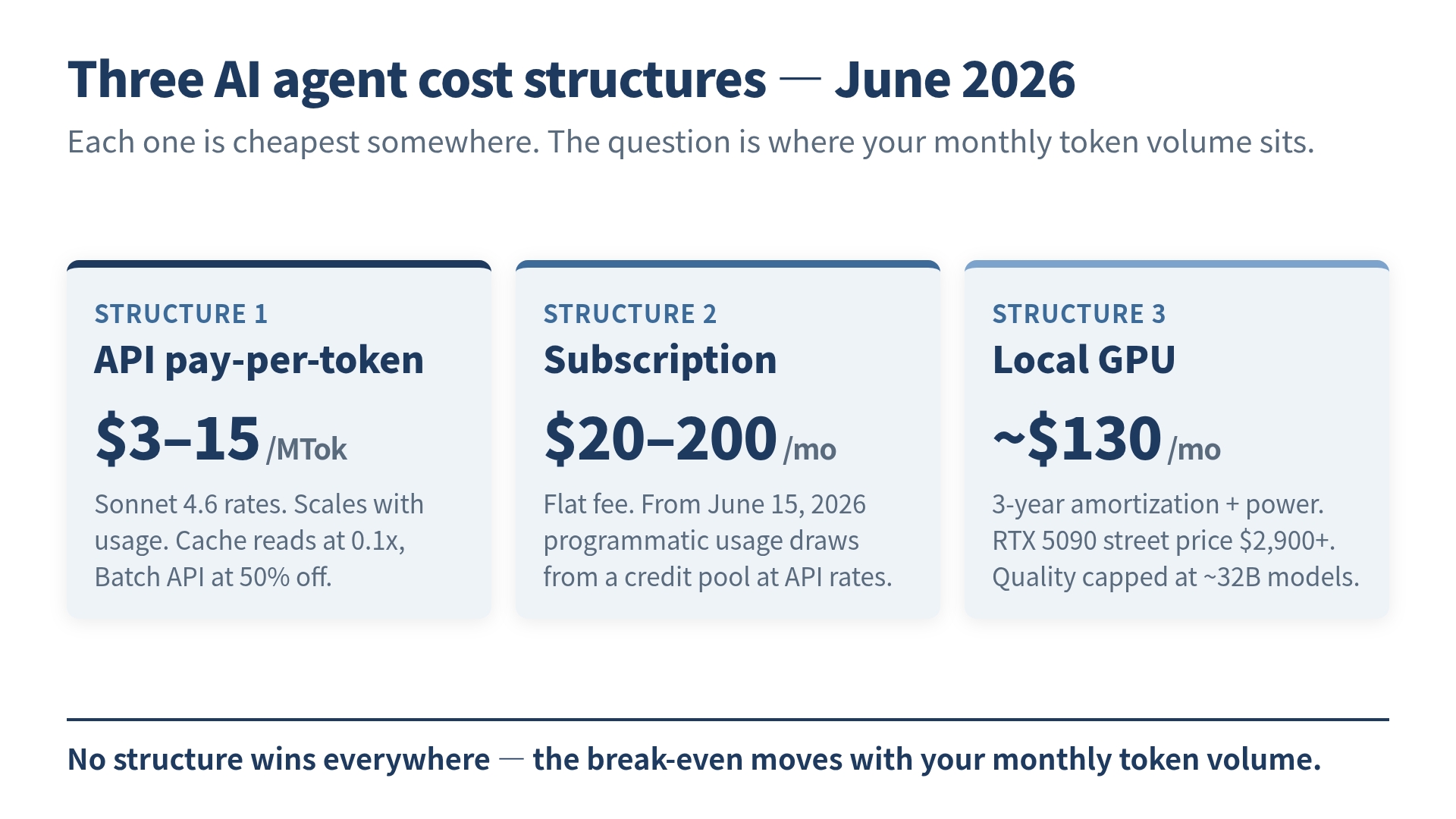
Every AI agent setup bills you one of three ways: metered API calls, a flat subscription, or hardware you own. Each one has a zone where it’s the cheapest option, and the zones moved this year.
Structure 1: API pay-per-token
You bring an API key, you pay for what you burn. Current Claude API pricing as of June 2026:
| Model | Input | Output | Notes |
|---|---|---|---|
| Claude Fable 5 | $10/MTok | $50/MTok | New top tier, 1M context |
| Claude Opus 4.8 | $5/MTok | $25/MTok | 1M context, no long-context premium |
| Claude Sonnet 4.6 | $3/MTok | $15/MTok | The workhorse |
| Claude Haiku 4.5 | $1/MTok | $5/MTok | Fast, cheap, 200K context |
One trap in that table: Fable 5 uses a new tokenizer that produces roughly 30% more tokens for the same content. The sticker says 2x Opus; the effective rate per task is closer to 2.6x. Budget by task, not by the price card.
Agents are not chatbots. A chatbot answers a question; an agent loops plan, execute, observe, fix, and the context pile grows on every lap. My real-world reference point: a refactoring session on a 300-file repository through Sonnet 4.6 burns 500K to 1M tokens. That’s $4.50 to $9 per session. Run two or three sessions a day and you’re at $200-500 a month before anyone notices.
Two levers cut that number hard:
- Prompt caching. Cache reads bill at about 0.1x the input price; writes cost 1.25x once. For an agent that re-reads the same system prompt and repo context every loop, this is routinely a 60-80% reduction on input cost. If you do nothing else from this post, verify your cache hit rate.
- Batch API. Anything that doesn’t need an answer in real time — nightly reports, bulk classification — runs at 50% off.
Best for: low frequency (a few sessions a month), per-task model switching, and anyone who needs a hard monthly ceiling — both Anthropic and OpenAI consoles support spend limits.
Structure 2: Subscription
Flat monthly fee, no per-token anxiety:
| Plan | Monthly | What you get |
|---|---|---|
| Claude Pro | $20 | Base usage limits + Claude Code |
| Claude Max 5x | $100 | 5x Pro limits + Claude Code |
| Claude Max 20x | $200 | 20x Pro limits + Claude Code |
The 2026 plot twist: starting June 15, 2026, programmatic Claude Code usage moves to a dedicated credit pool billed at API rates. Pro includes $20 of monthly credits, Max 5x includes $100, Max 20x includes $200. Interactive terminal sessions stay inside your subscription limits; your claude -p cron jobs and CI pipelines now draw from the pool.
I have seven cron agents that write content drafts overnight. For a year they were, in accounting terms, free riders on my Max plan. As of this week they have a budget line. I measured their first projected month against API rates: about $38 of the $100 pool. Survivable. But if you’ve built a heavy automation harness on a $100 subscription, run this measurement before the pool runs dry mid-month.
Best for: daily interactive use. If you’re burning 1M+ tokens a month in actual coding sessions, $100 flat beats the metered equivalent comfortably.
Structure 3: Local LLM
Ollama or vLLM on your own GPU. Zero API fees, but the hardware market in 2026 is openly hostile.
The RTX 5090 has a $1,999 MSRP that you will never see. DRAM prices are up roughly 170% year-over-year because AI datacenters bought the memory supply years in advance, and memory is up to 80% of a GPU’s bill of materials. Street prices in June 2026: mid-range AIB cards from about $2,900, premium models past $4,000. A used RTX 4090 holds around $1,800-2,200.
Realistic monthly cost for a 5090 box running 8 hours a day:
- Power (575W TGP): roughly $40-50/month depending on your rates
- Hardware amortized over 3 years at $3,000 street price: ~$83/month
- Total: ~$125-135/month, quality-capped at what a 32B model can do
Devstral and Qwen3-Coder at 24-32B handle routine coding tasks credibly. They do not handle architecture decisions or root-cause analysis at frontier level, and the gap shows up exactly when the work matters most. My 4090 spent most of last winter as the most precisely engineered space heater I own.
Best for: confidential data that can’t leave the building, offline requirements, and people who already own the GPU (the amortization argument dies if the card is sunk cost from your gaming era).
Where the break-even sits
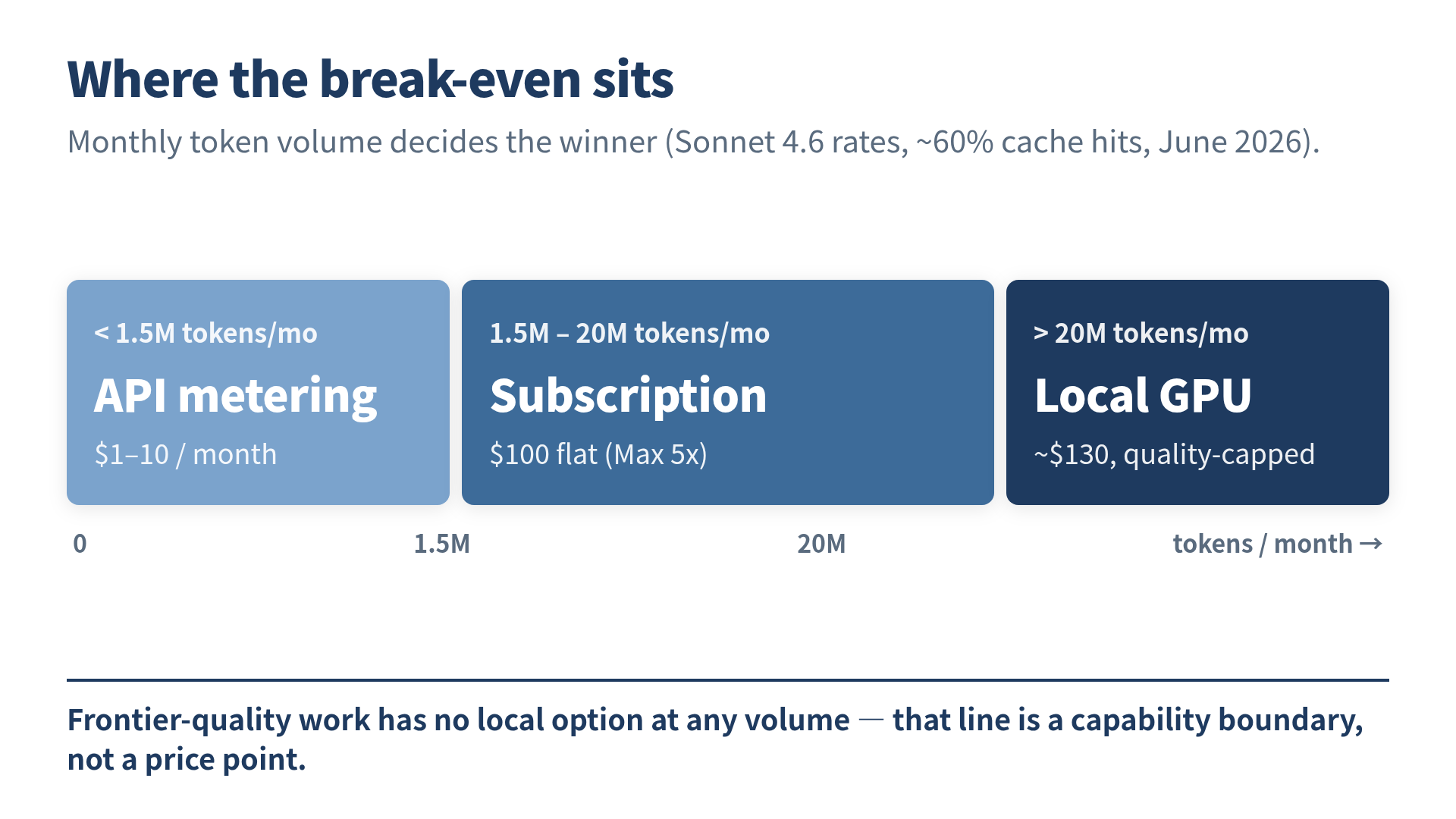
The variable that decides everything is monthly token volume. Here’s the formula, so you can plug in your own numbers instead of trusting mine:
monthly_api_cost = (input_MTok × input_rate + output_MTok × output_rate)
                   × (1 - cache_savings)

Compare against: $100 (Max 5x) or ~$130 (local GPU amortized)
With Sonnet 4.6 rates and a typical agent’s 70/30 input/output split, cache hits at 60%:
- Under ~1.5M tokens/month: API metering wins. You’re paying single-digit dollars.
- ~1.5M to ~20M tokens/month: Max 5x at $100 wins. The same volume metered would run $10-130 before cache savings, and the subscription removes the variance.
- Above ~20M tokens/month, quality-tolerant workloads: local starts to pay, if a 32B model is good enough for the task. For frontier-quality work there is no local option at any volume; that’s a capability boundary, not a price point.
The honest version of that third bullet: “cheap but worse” is a real trade, and it belongs in the budget math. My test for whether a local model is below the line: when code review starts catching things the model should have caught, the model is costing you more in review time than it saves in API fees.
My hybrid setup, with receipts
Locking into one structure is like building a house with only a hammer. Here’s my June 2026 split:
- Daily interactive coding: Claude Code on Max 5x ($100 flat)
- Cron/automation fleet: the new credit pool, projected ~$38/month at API rates
- Occasional heavy refactors: Opus 4.8 via API when precision matters, $10-20/month
- Client-confidential processing: Ollama + Devstral on the 4090, ~$15/month in power
Total: about $165-175/month. That’s more than I paid in May, entirely because of the June 15 change. It’s still less than the version of me that tried to cram everything into the Max limits, hit the rate ceiling mid-task, and did the remaining work by hand. Manual labor performed while waiting for a rate limit to reset is the most expensive compute tier of all.
The part nobody budgets: re-checking quarterly
This cost structure has a half-life of about three to six months. The things I’m watching for the rest of 2026:
- Whether the June 15 credit-pool model spreads from Claude Code to other vendors’ agent tools
- DRAM supply — if it recovers, the 5090 drifting back toward MSRP rewrites the local break-even
- The next generation of 30B-class coding models closing the quality gap from below
Reading pricing pages is nobody’s idea of engineering. But the person who can answer “how much per month?” in one sentence is the person whose agent project actually ships. Mine froze for three weeks over $350. The math in this post takes fifteen minutes. Cheap insurance.
If you want the full framework this thinking comes from — how to design, operate, and budget AI agent harnesses end to end — I wrote a 19-chapter book on it: Harness Engineering — From Using AI to Controlling AI.
 Related book Harness Engineering Five interpretations from OpenAI, Anthropic, LangChain, Martin Fowler, and academia — merged into one system for engineers running AI agents in production View the book page →
 Was this article helpful?