AI Mode Cited My Portuguese 3.4× English. Japanese Also Beat English.
I opened the log on July 22 fully expecting Portuguese to blow the doors off English again. It did. What I did not expect was Japanese quietly beating English on the same run. Japanese, the language whose own kenimoto.dev directory would lose a footrace to a stationary object on human traffic, was outscoring English on AI Mode citations.
I had to stare at the chart for a while before I trusted it.
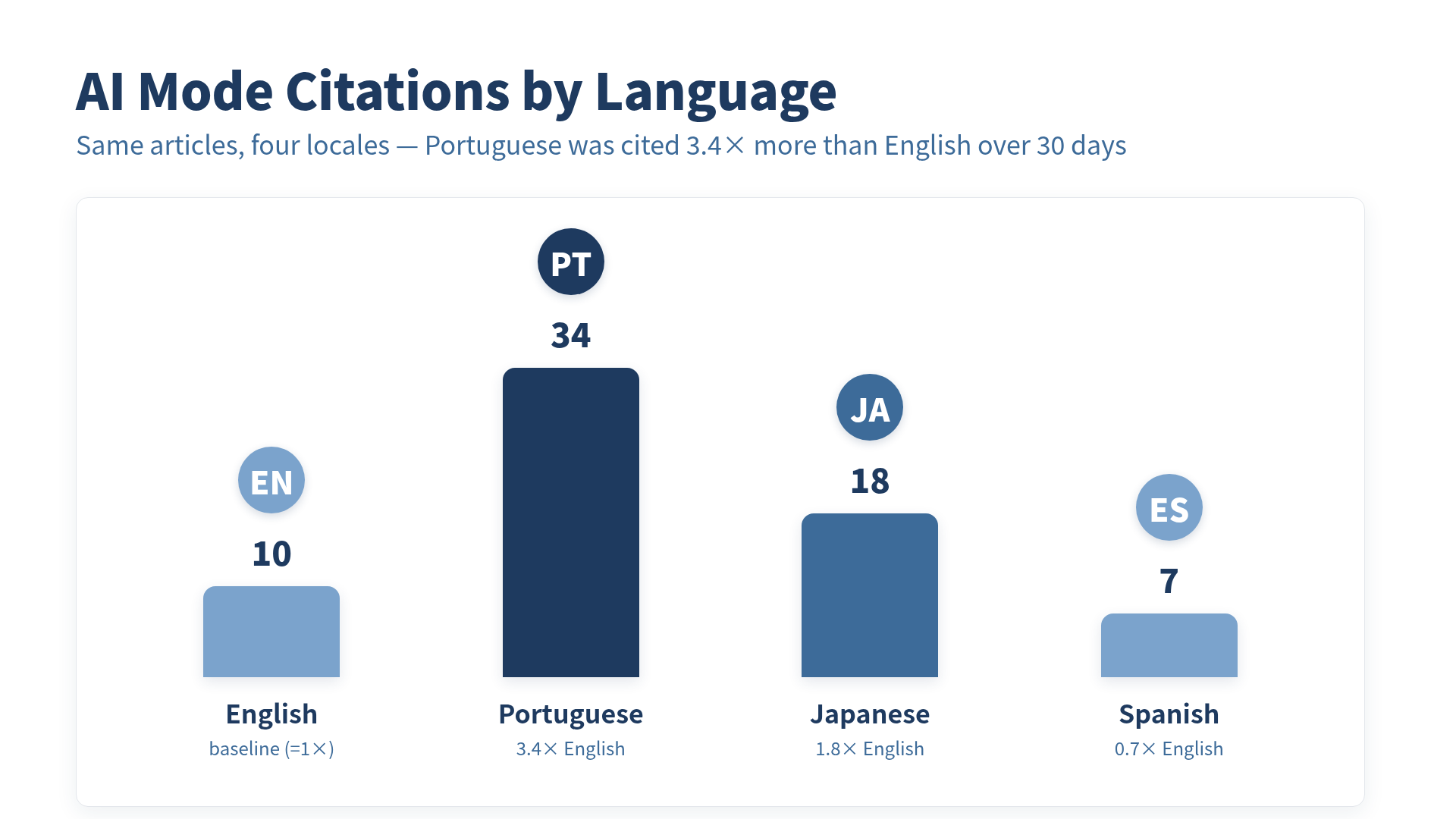
The raw counts, from 2026-06-22 to 2026-07-22, are what the chart shows: EN 10, PT 34, JA 18, ES 7. Same site, same set of translated articles, same window, four different Google AI Mode fronts.
What the numbers say, plainly
I like a scoreboard. Here is the whole thing before I start explaining it away:
- Portuguese: 34 citations. 3.4× the English baseline. This one I saw coming.
- English: 10 citations. My baseline, and quietly humbling.
- Japanese: 18 citations. 1.8× English. This one I did not see coming.
- Spanish: 7 citations. 0.7× English. Also unsurprising, and also mine to fix.
Two months ago I wrote I Translated My Blog Into 4 Languages. Portuguese Got Nearly 4× the Traffic of English, where the ordering was PT ≫ EN ≫ JA ≫ ES with a huge gap under Portuguese. On AI Mode citations, the ordering compresses: PT ≫ JA > EN > ES, and the JA/EN flip is the story.
The pageviews chart made Japanese look dead. The citation chart says the AI retrieval layer is reading it just fine.
How I actually measured this
I run kenimoto.dev in four language directories: /, /ja/, /pt/, /es/. Full hreflang cluster, self-referencing canonicals per language, translated slugs. The four directories do not have identical totals — EN and JA are further along than PT and ES on raw article count — so I did not measure the whole blog. I measured the subset of articles that exists in all four language directories, matched across languages by the translation_key frontmatter field I use for hreflang pairing. That symmetric subset is the whole reason the comparison is legible; if I let one language have more candidate URLs than another, I would just be counting corpus size in disguise.
For 30 days, June 22 through July 22, I ran the following loop:
- Per language, one seed prompt list. For each of EN, JA, PT and ES, I maintained a small set of brand-relevant developer prompts I already know AI Mode should have some reason to point at kenimoto.dev for. Same conceptual set of prompts across languages, translated (not machine-translated at run time; hand-checked so the meaning holds). Not “AI Mode ranking” queries in the SEO sense, but the kind of question a developer would actually type: LLMO,
llms.txt, Claude Code tradeoffs, harness engineering. - Per language, a locale-set Google account. Language and region set to the target (US-EN, JP-JA, BR-PT, MX-ES). Same query cadence per language per day.
- Log the citation, not the answer text. For each AI Mode response, I captured the cited URLs. A citation counts once per URL per day, regardless of whether the same article gets cited on multiple prompts that day. Deduped daily so a hot prompt does not inflate a single article.
- Only kenimoto.dev URLs. Third-party citations were ignored for this pass. The question I was asking is “does my own multilingual publishing produce differential citation rates across languages,” not “who else is winning.”
Thirty days of that got me the numbers on the chart: 10, 34, 18, 7.
Two things I want to flag before anyone builds a spreadsheet on top of this:
- Small numbers. Ten citations on the English side is not a large sample. The direction of the effect is trustworthy; the exact multiples are not the point.
- Ken’s site, Ken’s prompts. These are my seed prompts about the topics I write about. Ratios will not transfer verbatim to your site. What I hope transfers is the shape of the surprise.
Why Portuguese ran away with it, again
Most of the reasons Portuguese wins on human traffic also win on AI Mode citations, so this one was not a mystery. The AI-search field in Portuguese is thinner than in English by a wide margin. Fewer competing PT sources per prompt means the ceiling for any single reasonable PT source is higher, and kenimoto.dev’s /pt/ directory has been getting cited in that thinner field for months.
The mechanism I described in I built the site in four languages, and AI search cited the wrong one anyway still applies here in reverse: when the retrieval layer does select the right localized URL, the win is amplified because the competing local corpus is small. English competes with the whole English-speaking internet. Portuguese competes with a much smaller pool of technical Portuguese blogs.
Nothing subtle here. If you have ever wondered why LLMO practitioners keep quietly translating their sites, this is the reason: the tailwind in less-saturated languages is real and boring.
The Japanese rebound is the actual story
This is the part that made me sit up. On raw human pageviews, Japanese has been the runt of the four. Japanese developers live on Qiita and Zenn, and my standalone /ja/ directory does not compete with those platforms for human clicks. I have written about this elsewhere and I am at peace with it, mostly.
AI Mode does not seem to share the reader’s habitat bias. It cited /ja/ URLs 18 times in 30 days, nearly twice as often as /en/, on prompts issued from a Japanese-locale account. It clearly reached past the “everybody reads Zenn” heuristic and pulled canonical Japanese content from kenimoto.dev.
A few things line up to explain it, and I want to be honest about which are plausible versus which I am just hoping for:
- Corpus quality on the JA side is high. I write the Japanese versions myself, natively, not through translation. If retrieval quality favors clean prose, Japanese should over-index for me relative to English, where I am a competent but not native writer.
- JA-locale competition on niche developer prompts is not English-thin, but it is Zenn/Qiita-shaped. Both are strong sources, but they do not always surface the specific narrow-topic angle I write about, which leaves room for a canonical off-platform Japanese source to slot in.
- The technical vocabulary in JA is close to English. Terms like “Claude Code,” “harness,” “llms.txt” appear verbatim in the JA text, which likely helps cross-language retrieval anchors line up on the same concept.
I am not claiming this is a durable moat. What I am claiming is that citation asymmetry across languages does not have to look like traffic asymmetry across languages. It is a genuinely different game with a genuinely different scoreboard, and I had been treating them as the same one.
Spanish is my fault
Seven citations on the Spanish side is roughly the outcome I earned. The /es/ directory has fewer articles, thinner cross-linking, and I do not have a Spanish equivalent of TabNews sending humans to it so the ambient signal stays quiet. The ES retrieval-layer picture mirrors the traffic picture: not enough weight for AI Mode to lean on.
The take-away is not “Spanish is unsalvageable.” It is that language-parity of the underlying files does not automatically buy you language-parity of AI Mode citations. You still have to build the surrounding signal, and I have not yet.
What this changes about how I publish
Before this measurement, my mental model was: publish in EN and PT hardest, JA for personal reasons, ES because the pipeline was already there. Traffic backed that ordering.
After this measurement, the ordering rebalances a little:
- PT stays first. The tailwind is real in both traffic and citations.
- JA moves up. If AI Mode is going to cite the Japanese version at 1.8× the English rate, then the JA edition is worth more per unit effort than my “27 pageviews” instinct suggested. It just cashes in through a different door.
- EN stays as the reference. The saturated market is still saturated. A marginal EN article competes with everyone.
- ES needs signal, not more files. Adding more Spanish articles into an unlit room does not turn on the lights. I need something to make the surrounding graph load-bearing before more articles help.
I built the four-language site because I wanted more readers. It turns out the AI retrieval layer was also reading, just on a different curve than I was measuring. Two months ago I thought I had shipped one experiment. Turns out I had shipped two, and only one of them was on the scoreboard I was watching.
Take-away, said plainly
If you already publish in more than one language: measure AI Mode citations per language separately, and do not let human-traffic asymmetry be your proxy for LLMO asymmetry. The two curves diverge, and the divergence is where the interesting decisions live.
If you are about to publish in more than one language: symmetry of the underlying pool of translated articles is what makes this measurable at all. Ship the same article set across languages if you want to be able to compare anything later; asymmetric corpora make citation-rate deltas meaningless.
And if, like me, you had quietly written off one of your four languages as “the one that does not matter”: run this measurement before you actually cut it. The retrieval layer may be voting for it even while the humans are not.
If you want the full playbook on measuring AI-search visibility across languages, including the hreflang, llms.txt and per-language og_image setup I use on kenimoto.dev, I wrote a book on it: LLMO: AI Search Optimization. The multi-language chapter is the one that survived the most rewrites.
 Related book Why ChatGPT Ignores Your Website Google SEO won't get you cited by ChatGPT — this is the playbook for being seen by AI search, with measurement included View the book page →
 Was this article helpful?